
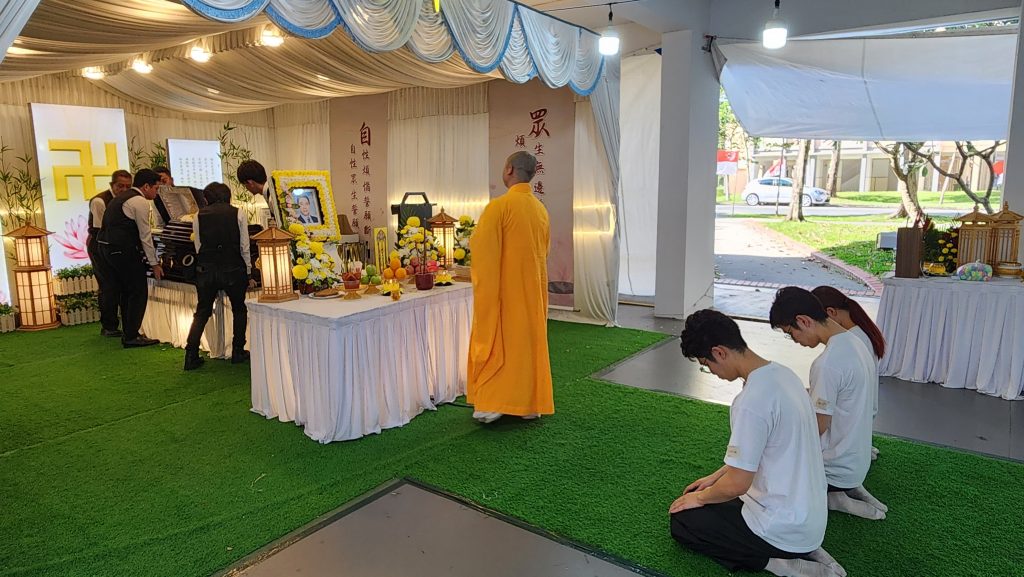
In our many years accompanying families through one of life’s most profound passages, we’ve have been asked the same question countless times: “Why do we need the monks to chant? Is it just tradition?” The answer, as we hope to show here, is layered: spiritual, psychological, cultural, and deeply personal. This guide aims to give you the most honest and thorough understanding we can offer.
1. Why Monks: And Not Just Recorded Chanting?
When families first ask us about chanting, many assume it is primarily about filling the space with sound, that a recording could serve the same purpose. This misunderstands what monks bring to the ceremony. A monk is not simply a chanting machine. They are a living embodiment of the Dharma: someone who has taken vows, cultivated their mind through years of practice, and whose very presence carries what Buddhists call spiritual authority.
In Buddhist philosophy, the intention behind an act matters enormously. When a monk recites the Amitabha Sutra, every syllable is accompanied by decades of training in concentration, compassion, and proper intonation. This quality of mind is believed to amplify the spiritual efficacy of the chanting far beyond what any recording can replicate. Think of it this way: a recorded prescription being read aloud is not the same as a doctor examining you in person.
2. The Five Core Reasons Families Engage Monks During Buddhist Funeral Services in Singapore
1. To guide the consciousness of the deceased
Buddhism teaches that at the moment of death, consciousness does not immediately disappear. In Mahayana traditions, the most widely practised in Singapore, the consciousness enters an intermediate state and may remain in a confused or disoriented condition, particularly in cases of sudden death.
Monks chant sutras specifically chosen to act as a spiritual compass: anchoring the consciousness toward calm, clarity, and a favourable direction of rebirth. The Amitabha Sutra and the continuous recitation of Namo Amituofo serve precisely this function, invoking the compassionate vow of Amitabha Buddha to guide all beings to the Pure Land.
2. To generate and transfer merit
One of Buddhism’s most powerful, and misunderstood, concepts is merit transfer (功德回向, Gōngdé Huíxiàng). The idea is that virtuous actions, including the sincere recitation of sutras, generate spiritual merit, which can be consciously dedicated to benefit another being, even after their death.
When monks chant on behalf of the deceased, this merit is formally transferred through the Transfer of Merit Verse at the end of the ceremony. Families who join in the chanting also contribute their own merit to this collective offering. It is an act of deep generosity, the last gift you can give to someone you love.
3. To purify karmic obstacles
Buddhist cosmology holds that we all carry karma, the accumulated weight of actions from this life and past lives. Certain chants, particularly dharanis like the Great Compassion Mantra (大悲咒) and the Amitabha Pure Land Rebirth Mantra, are considered especially powerful for purifying negative karma.
Monks, through their training, know the correct pronunciation, rhythm, and mindful application of these texts. This is not about bypassing consequences, it is about cultivating the spiritual conditions for the best possible next chapter for the deceased.
4. To create a sacred container for grief
Grief is chaotic. It destabilises families, makes people feel helpless, and creates a vacuum of meaning during one of life’s most difficult moments. The rhythmic, repetitive sound of chanting does something neurologically remarkable: it slows the breath, lowers cortisol, and draws the mind away from spiralling thoughts toward a single focal point.
Families who chant alongside monks often report a sense of calm and purposefulness, even in the middle of profound sorrow. The monks provide structure to grief. They transform a painful, formless experience into a meaningful ritual.
5. To honour and uphold filial piety
In Singapore’s Chinese-Buddhist cultural context, engaging monks is inseparable from the concept of filial piety (孝道, Xiào Dào). To do the utmost for a parent or elder at the time of death, to spare no effort in ensuring their spiritual wellbeing in the next life, is considered a fundamental moral duty.
Engaging monks is one of the most tangible ways a family can demonstrate this. In this sense, the decision to engage monks is not merely religious. It is a statement of love, duty, and respect.
3. Types Of Chants Used In Singapore Buddhist Funerals
Not all chanting is the same. Each sutra, mantra, and dharani has a distinct purpose, doctrinal origin, and appropriate context. Below is a curated breakdown of the chants most commonly heard at Singapore Buddhist funerals, and what they actually mean.
1. Amitabha Sutra
阿弥陀经 · Āmítuó Jīng
Describes Amitabha Buddha’s Pure Land and the conditions for rebirth there. Recited to orient the deceased’s consciousness toward this realm of peace and to deepen the faith of the living. Often chanted in long, continuous sessions during the wake.
2. Heart Sutra
心经 · Xīn Jīng
Despite being only 260 characters, it encapsulates the entire teaching of emptiness (śūnyatā). Chanted during the encoffining ceremony to help the consciousness release attachment to the physical body. Considered among the most potent of all Mahayana sutras.
3. Great Compassion Mantra
大悲咒 · Dàbēi Zhòu
An 84-line dharani invoking Guanyin Bodhisattva (Goddess of Mercy). Believed to be particularly powerful for purifying negative karma. Often recited when the family is concerned about the deceased’s past actions or when death was sudden or traumatic.
4. Namo Amituofo
南无阿弥陀佛
The single most common chant at Chinese Buddhist funeral services in Singapore. A mantra of homage to Amitabha Buddha, repeated continuously. Its simplicity is its power, it allows everyone in the room, monks and laypeople alike, to participate together with a unified intention.
5. Diamond Sutra
金刚经 · Jīngāng Jīng
Teaches the letting-go of all fixed ideas and concepts, including attachment to self. Some families request this sutra specifically because they believe it helps the deceased release ego-attachment, a key obstacle to a good rebirth, according to Buddhist teachings.
6. Abhidhamma Recitation
Pali · Taught by the Buddha
Chanted by Theravada monks (typically Thai or Sri Lankan tradition). Consists of philosophical categories of mind and matter. The act of reciting and sponsoring this recitation is considered a profound form of merit-making on behalf of the deceased.
7. Metta Sutta
Pali · Loving-kindness discourse
A discourse on radiating unconditional loving-kindness to all beings without exception. Particularly moving in a funeral context, it extends the benefit of good wishes from the mourners outward to the deceased and all beings who may be in need of compassion.
8. Bardo Thodol readings
Tibetan Book of the Dead
In Vajrayana (Tibetan) Buddhist funerals, trained lamas read specific passages from the Bardo Thodol into the ear of the deceased. This text is a guide through the intermediate state (bardo), describing what the consciousness may encounter and how to respond wisely.
9. Rebirth Mantra
往生咒 · Wǎngshēng Zhòu
A short but highly focused dharani dedicated specifically to aiding the consciousness in achieving rebirth in the Pure Land. Often recited in rapid repetition. Many families learn this mantra themselves so they can chant it continuously at the bedside immediately after death.
4. How Chanting Differs Across Buddhist Funeral Traditions In Singapore
Singapore is home to one of the most diverse Buddhist communities in Southeast Asia. A funeral director must understand that “Buddhist funeral” is not a monolithic term, the chanting practices, language of recitation, the number of monks engaged, and the ritual sequence all vary significantly depending on the family’s tradition.
| Tradition | Primary community | Language of chant | Key sutras / chants | Distinctive feature |
|---|---|---|---|---|
| Chinese Mahayana (Pure Land) | Singapore Chinese, Hokkien, Cantonese, Teochew | Mandarin or Hokkien transliteration of Sanskrit/Classical Chinese | Amitabha Sutra, Heart Sutra, Namo Amituofo, Great Compassion Mantra | Longest rituals (3–7 days); often includes Gong Teck ceremony with high-ranking monks; strong Taoist cultural overlay |
| Thai Theravada | Thai community, some Singaporean converts | Pali (the liturgical language of Theravada) | Abhidhamma, Metta Sutta, various Pali parittas (protection chants) | Simpler, more subdued ceremonies; cloth-offering ritual (paṃsukūla) to monks; chanting often faster in tempo |
| Sri Lankan Theravada | Sri Lankan community (Sinhalese Buddhist) | Pali | Abhidhamma, Metta Sutta, merit-transfer verses | Strong emphasis on almsgiving alongside chanting; merit-sharing (pattidāna) is central to the rite |
| Tibetan Vajrayana | Tibetan community, some Singaporean Vajrayana practitioners | Tibetan (Classical) | Bardo Thodol readings, Om Mani Padme Hum, Phowa practice | May begin before death if possible; the concept of consciousness transference (Phowa) is unique to Vajrayana; lamas perform elaborate visualisation practices alongside chanting |
| Burmese Theravada | Burmese community in Singapore | Pali | Abhidhamma, Buddhist parittas | Multi-night Abhidhamma recitations; monks recite in relay throughout the night of the wake |
5. When Buddhist Funeral Chanting Happens: The Full Ritual Timeline
Chanting is not confined to a single session. It punctuates the entire journey from death to post-funeral observances. Understanding the timeline helps families plan and participate meaningfully.
1. At the moment of death (or shortly after)
The family, or a monk if available, begins chanting the Rebirth Mantra (往生咒) or Namo Amituofo at the bedside. The body should ideally not be moved or touched for up to 8 hours, as the consciousness is believed to still be present. Soft chanting creates a calm environment for this transition.
2. Opening ceremony at the wake (Day 1)
Monks arrive to conduct an opening chanting session, setting the spiritual tone of the wake, purifying the space, and formally commencing the funeral rites. The altar is consecrated. The Heart Sutra is commonly chanted at this stage.
3. Daily chanting sessions throughout the wake (Days 1–3 or longer)
Monks typically visit once or twice a day. Each session may include the Amitabha Sutra, Great Compassion Mantra, and the Transfer of Merit Verse. Family members and friends are encouraged to join. Recorded chanting may be played between sessions.
4. Encoffining ceremony
A particularly solemn moment when the body is placed in the coffin. The Heart Sutra is chanted to help the consciousness accept the departure from the physical form. Monks lead and family members follow in a slow, unified recitation.
5. Final chanting on the day of cremation or burial
The most emotionally intense session. Monks chant continuously during the procession and at the crematorium or burial ground. This chanting accompanies the final departure, and monks’ blessings are believed to ease the transition of the physical remains.
6. Post-funeral memorial rites (7th, 14th … up to 49th day)
Chanting sessions are held every 7 days for 49 days, corresponding to the believed duration of the intermediate state (bardo). Each session continues the merit transfer and provides ongoing spiritual support for both the deceased and the grieving family.
7. 100th day and Gong Teck ceremony
The 100th day marks an additional milestone. Families may also commission a Gong Teck (功德) ceremony, a grand merit-making rite conducted by senior monks with elaborate offerings. This is considered one of the most powerful acts a family can perform for the deceased’s continued wellbeing in the next life.
6. Nuances And Insights Most Singaporean Families Don’t Know
1. The state of mind of the dying person matters enormously
Buddhism places tremendous importance on the quality of consciousness at the moment of death. A calm, clear, compassionate state of mind is believed to create the conditions for a good rebirth.
This is why chanting often begins before death, if the person is terminally ill and the family has time to prepare. Monks will sometimes visit the dying person in hospital or at home, chanting gently to create a peaceful environment. Families who plan ahead for this can give their loved one an immeasurable gift.
2. The number of monks matters, but not in the way you think
Families sometimes ask: “Is it better to have more monks?” From a spiritual standpoint, what matters most is the sincerity and training of the monks present, not the quantity. One highly trained, deeply focused monk is more meaningful than five monks going through the motions mechanically.
That said, for multi-day wakes and extended chanting sessions, having two or three monks allows for relay chanting, sustained, unbroken recitation over many hours, which is considered spiritually more powerful than intermittent sessions.
3. Family participation is not optional, it is spiritually significant
In many families we have worked with, the laypeople sit and observe while the monks chant. This is understandable, grief is exhausting and the texts are unfamiliar. However, Buddhist teaching is clear: the collective intention of everyone present amplifies the merit generated.
Even softly repeating “Namo Amituofo” alongside the monks, or simply sitting with a sincere and compassionate heart, contributes to the ceremony’s spiritual efficacy. I always gently encourage families to participate, even minimally.
4. Recorded chanting: when it helps and when it doesn’t
Recorded chanting serves a legitimate purpose, it maintains a spiritual atmosphere during the long hours between monk visits and prevents the wake from falling into casual conversation that may be jarring in the context of a solemn event.
However, it should never be seen as a full substitute for live monk chanting. The distinction is intention and presence. A recording has no awareness, no compassion, no ability to respond to the specific needs of the deceased or the family. Use recordings as a complement, not a replacement.
5. A lesser-known insight
In Tibetan Vajrayana tradition, the practice of Phowa (consciousness transference), performed by a qualified lama at the moment of death, is considered more important than any post-death ceremony.
It is a meditation technique that literally guides the consciousness out of the body through the crown of the head, directing it toward a higher rebirth. This is a deeply esoteric practice unavailable to most families, but it illustrates how much depth and nuance exists across different Buddhist approaches to death.
7. Common misconceptions
Misconception 1: “Chanting is just a formality, it doesn’t really do anything.”
What’s actually true: Chanting operates on multiple levels simultaneously: spiritually for the deceased, psychologically for the living, and communally for the group. Even secular research shows sustained chanting reduces physiological stress markers in participants.
Misconception 2: “Any monk from any temple can perform any Buddhist funeral.”
What’s actually true: Theravada and Mahayana monks are trained in different liturgical traditions. A Theravada monk would not typically perform a Chinese Mahayana funeral. Matching the right tradition to the family’s practice is important.
Misconception 3: “The deceased is gone, the chanting is just for the living to feel better.”
What’s actually true: Buddhist teaching holds that consciousness continues after physical death. Chanting is considered to have a direct effect on the deceased’s intermediate state experience. The benefit for the living is real, but it is not the only purpose.
Misconception 4: “More expensive chanting packages are always spiritually superior.”
What’s actually true: Spiritual efficacy is not proportional to cost. A sincere, well-trained monk chanting with genuine compassion for an hour is worth more than a perfunctory session of any length. Choose based on alignment and sincerity, not prestige.
8. Practical FAQs For Buddhist Families In Singapore
1. How do I know which tradition of monks to engage?
Follow the tradition the deceased practised during their lifetime. If they regularly attended a Theravada temple, engage Theravada monks. If they were a Chinese Pure Land Buddhist, engage Mahayana monks. If unsure, the family’s home temple or your funeral director will be able to advise. Consistency with the deceased’s own faith and practice is the most respectful approach.
2. How many monks should we engage?
For a 3–5 day wake, 1–3 monks is standard. One monk is appropriate for smaller, more intimate services. Two or three monks are recommended if the family wishes extended chanting sessions, relay chanting through the night, or multiple sutra recitations per day.
3. Can non-Buddhists participate in the chanting?
Absolutely. Non-Buddhists need not recite the sutras, simply sitting quietly with a respectful, compassionate attitude is entirely appropriate and is considered contributing to the spiritual atmosphere. If a non-Buddhist wishes to join in, they may gently repeat “Namo Amituofo” without it carrying any religious obligation.
4. What should family members do during chanting sessions?
Join in if you know the chants, or sit quietly with palms joined and a sincere heart if you don’t. Avoid side conversations or using your phone. When monks rise to leave, the family should stand as a mark of respect. Offering incense before and after each session is customary.
5. Is it necessary to continue chanting after the funeral?
From a doctrinal standpoint, yes, particularly for the 49-day period when the consciousness is believed to still be transitioning. Even if full chanting sessions are not possible every 7 days, sponsoring a chanting session at the family’s temple, or the family gathering to chant Namo Amituofo together, carries real meaning and is deeply valued in Singapore Buddhist culture.
6. What is the Gong Teck ceremony and should we consider it?
Gong Teck (功德) is a large-scale merit-making ceremony typically involving senior monks, elaborate offerings, and the burning of paper replicas. It can be held on the 49th day, 100th day, or 1st and 3rd year anniversary.
While it involves considerable cost and planning, many families find it brings tremendous peace of mind, the sense that they have done everything within their power for their loved one. It is not obligatory but is deeply meaningful when done with sincere intention rather than social obligation.
A Word On Sincerity By Solace Bereavement Funeral Services
In all our years in this profession, we have come to believe that what matters most in any funeral service, Buddhist or otherwise, is not the scale of the ceremony, the number of monks, or the expense involved.
It is the quality of intention behind it. A family that chants one sutra with full heart, full presence, and genuine love for their departed one does more than a grand ceremony attended distractedly. The Dharma has always taught that the mind leads everything. Let your heart lead this too.
Contact us if you have any questions.